
Google's Spam Update Just Took 14 Days Instead of 2 — Here's What Else Moved for Small Business AI This Week (October 2026 Roundup)
Chris Corsaro · October 17, 2026
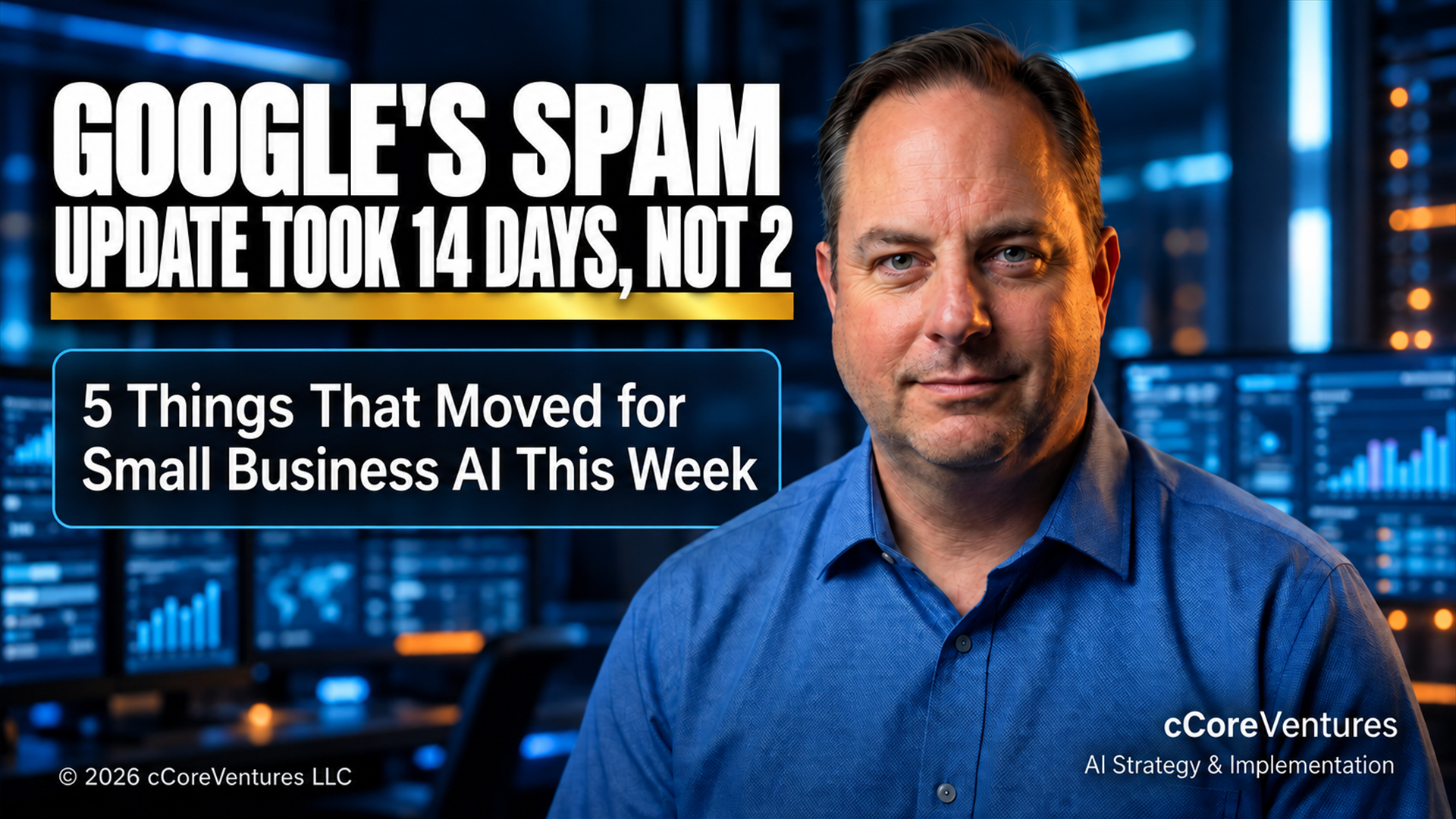
This week's AI news for small business: Google's spam update ran 7x longer than normal, GPT-6's interactive answers hit free users, Google retires Gems for Skills, and ChatGPT is about to test ads on free accounts.
If your rankings have felt like a seesaw since late September, you weren't imagining it — and now there's a number for why. Google's September 2026 spam update just finished rolling out after 14 days, when similar updates earlier this year wrapped in about two. That's the headline, but it's not the only thing that moved this week that touches how your business gets found, what you're paying for AI, and what your customers are about to start seeing inside ChatGPT. Here are five things worth five minutes of your Saturday coffee.
1. Google's Longest Spam Update of the Year Is Finally Over
Google confirmed its September 2026 spam update finished rolling out on October 8, around 4:37am ET — a full 14 days after it began on September 24. For comparison, earlier spam updates this year typically wrapped in about two days.
- Google's own description: it "applies globally and to all languages" and is "normal spam" — nothing structurally new, just another enforcement pass.
- The length of the rollout matters more than the description suggests. A two-day update is a quick sweep. A two-week update means Google's systems kept finding and reclassifying sites well past the initial pass — which is exactly why volatility tools showed rankings moving in waves through late September and into the first week of October, not just once.
- Sites that weren't doing anything spammy can still get caught in the blast radius of an update like this, especially ones with thin AI-generated pages, aggressive affiliate layouts, or content clearly built to game rather than answer a question.
Do this now: If your traffic dipped anytime between September 24 and October 8 and hasn't recovered, don't assume it's a glitch that'll fix itself — a 14-day rollout is Google telling you it looked hard. Pull Search Console, check your lowest-performing pages from that window, and ask honestly whether any of them read like they were written to rank instead of to help. If you've been leaning on AI drafting tools without a real edit pass, this is exactly the gap we flagged a few weeks back — it's not that AI content gets penalized by default, it's that thin, unedited AI content is the easiest thing for an update like this to catch.
2. GPT-6's "Intelligent UI" Just Went Free — Interactive Answers Are the New Battleground
OpenAI's GPT-6 update that lets answers include interactive elements — calculators, comparison tables, mini-tools built on the fly — rolled out to Plus, Pro, Business, and Enterprise on October 7, and hit Free and Go accounts on October 8. That's the overwhelming majority of ChatGPT's user base now getting answers that don't just describe something — they let the user interact with it inside the chat.
- This changes the AEO calculus. If someone asks ChatGPT "what would a website redesign cost for my business," the answer might now include a live calculator instead of a paragraph citing your blog post. Your content doesn't just need to be citable — it needs to be structured in a way a model can turn into something interactive.
- Practically: the content that wins here is the content built around a clear number, formula, or decision tree — a cost range, a checklist, a yes/no framework — not a wall of prose. Models can't build an interactive tool out of a vague opinion piece.
- This is a direct extension of the GEO/AEO shift we've been tracking: position on a results page matters less every month; what matters is whether your actual numbers and frameworks are clean enough for a model to lift and rebuild.
Do this now: Look at your highest-value service page and ask: is there a number, calculator, or step-by-step framework buried in there that a model could turn into an interactive answer? If it's all narrative, that's your next content project.
3. Google Is Quietly Killing "Gems" — "Skills" Roll Out to the Gemini App This Week
Google announced on September 30 that reusable custom instructions are getting rebuilt from the ground up as "Skills," replacing the current Gems feature. The rollout has been staged: Google Workspace got it starting October 5, and the consumer Gemini app rollout lands this week, October 13, with Google's Scheduled Release channel following October 19.
- Skills work like a saved, reusable instruction set — closer to a lightweight custom agent than the simple saved-prompt feel of Gems. Think "my brand voice + my FAQ answers + my pricing rules," saved once and reused every time instead of re-explained in every chat.
- The catch: Skills don't currently sync between the Gemini app and Workspace, so anything you build in one won't automatically show up in the other — build it twice if you use both.
- Gems isn't disappearing overnight for paid plans — Google says Business and Enterprise Gems removal is no sooner than March 2027 — but if you're a free or Workspace user actively building reusable prompts, this is the week to start moving your best ones over rather than finding out later your saved Gems quietly stopped working.
Do this now: If you've built even one reusable Gemini prompt for your business — a customer-response template, a content-brief generator, a pricing-question answer — this week is the right time to test rebuilding it as a Skill once it's live in your app, so you're not caught flat-footed when Gems eventually sunsets.
4. ChatGPT Is About to Test Ads on Free Accounts
OpenAI began a limited test on October 5 showing visual ads to select US advertisers and a slice of Free/Go users, with a broader test planned for later this month. OpenAI also expanded its "Negative Phrases" targeting control to qualifying advertisers in the same window.
- This is a notable reversal in tone. OpenAI spent most of 2025 and early 2026 positioning ChatGPT as ad-free; a visible ad test on free accounts signals the monetization pressure is real, and it's coming to the interface your customers increasingly research through before they ever hit Google.
- It also lands right after ChatGPT Ads opened to small businesses directly a few weeks ago — so the platform is simultaneously building out the advertiser side and testing where those ads actually show up for consumers. Expect this to move fast once it's confirmed working.
- For your marketing plan, the practical read is: budget a small test allocation for ChatGPT Ads now, while competition and CPMs are still low, rather than waiting for this to be common knowledge among every agency and competitor in your market.
Do this now: If you haven't looked at ChatGPT Ads at all yet, this week is the signal to at least open the self-serve dashboard and see what a $100-$200 test campaign would look like. You don't need to commit — you need to not be the last business in your category to try it.
5. Running AI Just Got Cheaper Again
Two pricing moves this week push the cost of AI-powered workflows down further for small businesses that are watching every dollar:
- GPT-6.1 Sol launched at $2 per million input tokens / $10 per million output tokens — one-fifth of the flagship GPT-6 Astra rate — with cached input at just $0.10 per million.
- Claude Haiku 5.5 is priced for high-volume, simple tasks at $0.10 input / $0.50 output per million tokens (up to 100,000 prompt tokens; $0.50/$2.50 above that) — squarely aimed at the kind of repetitive, high-volume work (customer replies, data tagging, basic drafting) small businesses actually run at scale.
- Anthropic also rolled out pooled Claude Max and Team API credits this week ($100-$500/month depending on tier) for eligible subscribers, which is a meaningful discount if you're already paying for Claude seats and building anything custom on top.
Do this now: If cost has been the reason you held off on automating a repetitive workflow — email triage, review responses, basic content tagging — re-run that math today. The per-task cost of a "good enough" model has dropped again, and it's now cheap enough that the real blocker probably isn't price anymore. We've broken down exactly where AI cost traps still hide if you want the fuller picture.
What To Actually Do This Week
- Pull Search Console now and compare September 24-October 8 against the two weeks before — a 14-day update means a slow recovery is normal, but a flat drop that hasn't budged is worth a real content audit.
- Find your best service or pricing page and ask if a number, calculator, or framework in there could become an "interactive answer" inside ChatGPT — restructure it if it's all prose.
- If you use Gemini's Gems feature, test migrating your best saved prompt to a Skill once it's live in your app this week.
- Open the ChatGPT Ads self-serve dashboard and price out a small test campaign before the free-tier ad test makes this common knowledge.
- Re-check whether a repetitive manual task is still too expensive to automate — Haiku 5.5 and GPT-6.1 Sol pricing probably changed that math.
FAQ
My traffic dropped during the September spam update — what should I actually do first?
Check whether the drop is broad (many pages, not just one) and whether it's held for more than a week past the October 8 completion date. If both are true, audit your weakest-performing pages for thin or unedited AI content before changing anything else.
Do I need to rebuild my content around calculators and tools now that GPT-6 has interactive answers?
Not from scratch — but any page built around a vague opinion instead of a clear number, range, or step-by-step framework is now less useful to a model trying to build an interactive answer out of it. Start with your highest-traffic page.
Should I worry about Gemini's Gems feature disappearing?
Not urgently if you're on a paid Business or Enterprise plan — Google says removal is no sooner than March 2027. If you're a free or Workspace user actively relying on saved Gems, start testing the Skills migration this week instead of waiting.
Is it worth testing ChatGPT Ads before the platform is fully built out?
Yes, in small amounts. Early advertiser pools tend to mean lower competition and lower cost per result — the same dynamic that made early Facebook and early TikTok ads cheap for whoever showed up first.
The Pattern Behind All Five Stories
Every story this week is really the same story: the rules for getting found, getting cited, and getting a customer's attention are being rewritten in real time, and most small businesses are finding out weeks after the fact instead of while it's happening. That's the exact gap cCoreVentures' AI Strategy & Implementation practice exists to close — not by chasing every headline, but by building the systems, content structure, and tool stack that keep working no matter which update, model, or ad test lands next. If you want a straight read on where your business stands against everything that moved this week, reach out and let's talk.
Recent articles
- LinkedIn Just Launched a $99 AI Toolkit for Small Business — Here's What's Actually Worth Paying ForLinkedIn's new Premium All-in-One bundles AI hiring, paid consultations, and prospecting into one $99.99/month plan as US founders on the platform surge 70%. Here's what's hype and what's actually worth your budget.
- llms.txt Won't Get You Cited by ChatGPT — Here's What Actually Willllms.txt adoption is up 8.8x this year, but new server-log data shows 97% of these files get zero AI requests. Here's what actually gets small businesses cited by ChatGPT, Gemini, and Perplexity.
- ChatGPT Ads Are Open to Small Businesses Now — Here's What That Changes About Your Marketing BudgetOpenAI dropped the $50K minimum and opened ChatGPT Ads to small businesses the same week data showed 68% of Google searches end without a click. Here's what to do about it.
Explore our CoreSolutions, CoreServices, or all articles.