
ChatGPT Ads Are Open to Small Businesses Now — Here's What That Changes About Your Marketing Budget
Chris Corsaro · October 14, 2026
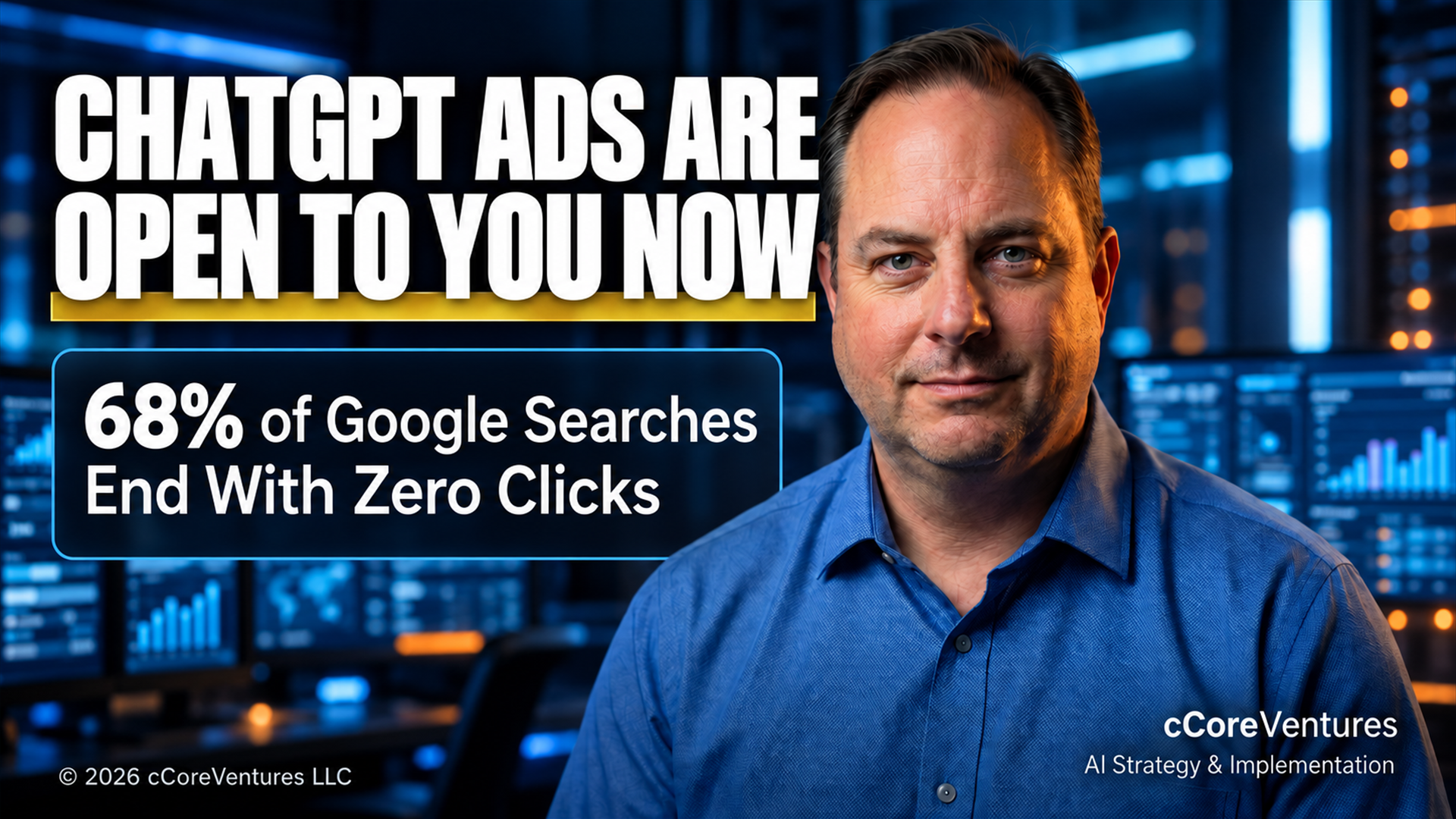
OpenAI dropped the $50K minimum and opened ChatGPT Ads to small businesses the same week data showed 68% of Google searches end without a click. Here's what to do about it.
Two things happened within days of each other this month, and if you run a small business, you need to see them side by side, not as separate headlines.
First: OpenAI quietly dropped the $50,000 minimum spend that used to gate ChatGPT Ads to big agency clients, and opened a self-serve Ads Manager to any US advertiser. You can now set a budget, upload a creative, and run ads inside ChatGPT without an agency in the middle.
Second: new panel data shows 68% of Google searches in early 2026 ended with the person clicking nothing at all — no website, no ad, nothing. That's up from 60% just two years ago, and it's the fastest the zero-click rate has ever moved.
Put those together and the math is simple. The place your customers search is changing faster than your marketing plan is. If your entire strategy is still "rank on Google, hope for a click," you're optimizing for a smaller and smaller slice of a shrinking pie, while a brand-new paid channel just opened its doors to businesses your size for the first time. This is exactly the kind of fork in the road we built cCoreVentures to help small business owners read correctly — not react to.
The Old Playbook Is Breaking Faster Than Most Owners Realize
For a decade, the small business marketing formula was simple: get found on Google, get the click, convert the visitor. That formula is quietly failing.
- Zero-click searches hit 68.01% in the first four months of 2026, according to Similarweb panel data cited by SparkToro — up from 49% in 2019 and 60.45% in 2024. That's a 7.5-point jump in just two years, the sharpest acceleration in a decade of measurement.
- Overall click volume fell about 23% between 2024 and 2026 — the largest single change ever recorded in this data.
- AI Overviews now appear on more than 20% of searches, and per Ahrefs data, they cut click-through rate by nearly 60% on the queries where they show up.
- Google's AI Mode already has over 1 billion monthly users, with query volume more than doubling each quarter, according to Google's own numbers from I/O 2026. It's not yet a huge share of total search, but it's the fastest-growing piece of the pie.
None of this means SEO is dead. It means SEO alone isn't the whole strategy anymore. We covered part of this shift when AI Overviews started eating organic traffic and again when we broke down why Google isn't actually penalizing AI-assisted content — the throughline in both is the same: visibility is moving from "ranked link" to "cited answer," and most small business sites aren't built for that yet.
What Actually Changed With ChatGPT Ads
This isn't a rumor or a beta waitlist anymore. Here's what's real as of this month:
- The $50,000 minimum spend is gone. That was the wall keeping small businesses out. It's down, and OpenAI's own monetization lead has said directly that this opens the platform to smaller advertisers.
- It's self-serve. You register, set your own budget and bids, upload your own creative, and manage the campaign yourself — no agency required to get started.
- Billing now supports CPC, not just CPM. You can pay per click instead of per thousand impressions, which matters a lot for a small business watching every dollar.
- There's a real conversions API and pixel tracking. You can tie an actual purchase, lead, or signup back to an ad someone saw inside a ChatGPT conversation — this is closer to performance marketing than brand awareness spend.
- OpenAI is scaling this hard. Reporting puts their ad revenue target at $2.5 billion this year, climbing toward $100 billion by 2030. That's not a side experiment — that's a platform they intend to make central to how the product makes money, which means it's going to get more competitive, not less, every month it's live.
Here's the part most owners miss: every new ad platform has a window where early advertisers get cheaper clicks and less competition, simply because most of the market hasn't shown up yet. That window is open right now on ChatGPT Ads. It will not stay open.
Nobody Is Actually Measuring Any of This Correctly
Here's the uncomfortable part. Even as AI search eats more of the pie and AI ad platforms open up, the industry still doesn't agree on how to measure whether it's working.
The Interactive Advertising Bureau published a framework this year called "Measuring Visibility in the AI Era." The headline number inside it: only 16% of brands systematically track their AI visibility today. Not 16% doing it well — 16% doing it at all.
The IAB's framework draws a useful line between two tiers:
- Directional measurement — good enough to spot a trend, not good enough to justify a budget decision.
- Decision-grade measurement — rigorous enough in sample size and method to actually act on.
Most of the 20-plus vendors now selling "AI visibility tracking" tools are operating in the directional tier, each with their own definitions of what counts as a "mention" or a "citation." Translation for a small business owner: if someone tries to sell you a dashboard claiming to show exactly how often ChatGPT or Gemini recommends you, read the fine print. We've written before about how ghost citations are quietly distorting these numbers and why tracking AI citations properly takes more rigor than most tools admit to. The framework also explicitly does not cover paid placements inside AI answers yet — which means the ad-visibility measurement gap is even wider than the organic one.
If 84% of brands aren't tracking this at all, that's not a reason to panic. It's a competitive opening. Decision-grade visibility — knowing specifically what AI tools say about you, your competitors, and your category — is still a wide-open advantage for whoever builds the habit first.
What To Actually Do This Week
Here's the practical version, in the order we'd walk a client through it:
- Audit your current AI visibility before spending a dollar on ads. Ask ChatGPT, Gemini, Claude, and Perplexity your top 5-10 buyer questions and record whether you show up, how you're described, and who gets recommended instead. This takes an hour and tells you more than most paid tools will.
- Test ChatGPT Ads with a small, bounded budget. Not your whole marketing spend — a test budget, with a hard conversion goal and a 30-day review. Early-mover pricing on a new platform is a real, if temporary, advantage.
- Don't abandon SEO — rebuild your content to be citation-worthy. That means direct, answer-shaped subheadings, clean structured data, and content that states facts plainly enough for an AI model to quote you accurately. This is the core of a real multi-platform GEO strategy, not a bolt-on.
- Pick one measurement habit and stick to it. Even a simple monthly log of "what did AI tools say about us" beats zero tracking. Decision-grade measurement can come later; directional-but-consistent beats sophisticated-but-abandoned.
- Reallocate, don't just add. If 23% of your expected click volume evaporated in two years, some of that budget belongs in AEO/GEO content work and a small ChatGPT Ads test — not just more of the same SEO spend chasing a shrinking click pool.
FAQ
What are ChatGPT Ads, and can a small business actually use them now?
Yes. As of this month, OpenAI removed the $50,000 minimum spend requirement and opened a self-serve Ads Manager to any US advertiser, letting small businesses set their own budget and run campaigns without going through an agency.
Why are so many Google searches ending without a click?
AI Overviews and similar instant-answer features now appear on over 20% of searches and cut click-through rate by close to 60% when they show up. Combined with more people re-searching instead of clicking and social platforms acting as search alternatives, the zero-click rate hit 68% in early 2026.
Is AEO or GEO different from regular SEO?
They're related but not identical. Traditional SEO optimizes to rank a link. AEO (answer engine optimization) and GEO (generative engine optimization) optimize your content to be accurately cited inside an AI-generated answer, which rewards clear, structured, fact-forward writing over keyword density alone.
How do I find out if my business shows up in AI search results right now?
Ask ChatGPT, Gemini, Claude, and Perplexity the questions your customers would actually ask before buying — and note whether you're mentioned, how accurately, and who gets recommended in your place. That manual audit is the starting point before any paid visibility tool.
The Bottom Line
The businesses that win the next two years of this shift won't be the ones with the biggest ad budget. They'll be the ones who noticed the floor moved first — that search is becoming "ask and get an answer" instead of "search and pick a link" — and adjusted their content, their measurement, and their ad spend accordingly, while most of the market is still arguing about whether SEO is dead.
It isn't dead. It's being rewritten in real time, and the rules are being set this quarter, not next year.
If you want a second set of eyes on where your marketing budget should actually move right now — SEO, AEO, GEO, or a test run on ChatGPT Ads — that's exactly the kind of strategy work cCoreVentures does for small businesses every day. Book a free AI strategy session and we'll tell you straight where your gaps are and what to fix first.
Follow & share
Recent articles
- No-Code AI Agents Just Got Real: What Claude Cowork and the ChatGPT Apps SDK Mean If You Can't Afford a Dev TeamNo-code AI agents for small business, explained: Anthropic's Claude Cowork just expanded to mobile and web, and OpenAI's Apps SDK keeps adding capabilities. Here's what these tools can actually build and automate for you this month — no developer required.
- AI Agents Instead of Employees: What the 2026 Hiring Data Actually Shows Small Business OwnersAI agents instead of employees: new 2026 data shows hiring-intent business applications down 4.4% while small business tech spending jumps 14% — and one 13-person company is running $1M a month. Here's what the numbers mean for your next hire.
- Does Google Penalize AI Content? What This Week's Authorship Crackdown Really Means for Small BusinessGoogle just warned that fake AI "authors" signal a low-quality page. Here's what actually changed in this week's spam enforcement, plus GPT-6's new interactive ChatGPT answers and two AI labs' unintended-action reports — and what small business owners should do about all three.
Explore our CoreSolutions, CoreServices, or all articles.