
AI Agents Instead of Employees: What the 2026 Hiring Data Actually Shows Small Business Owners
Chris Corsaro · October 12, 2026
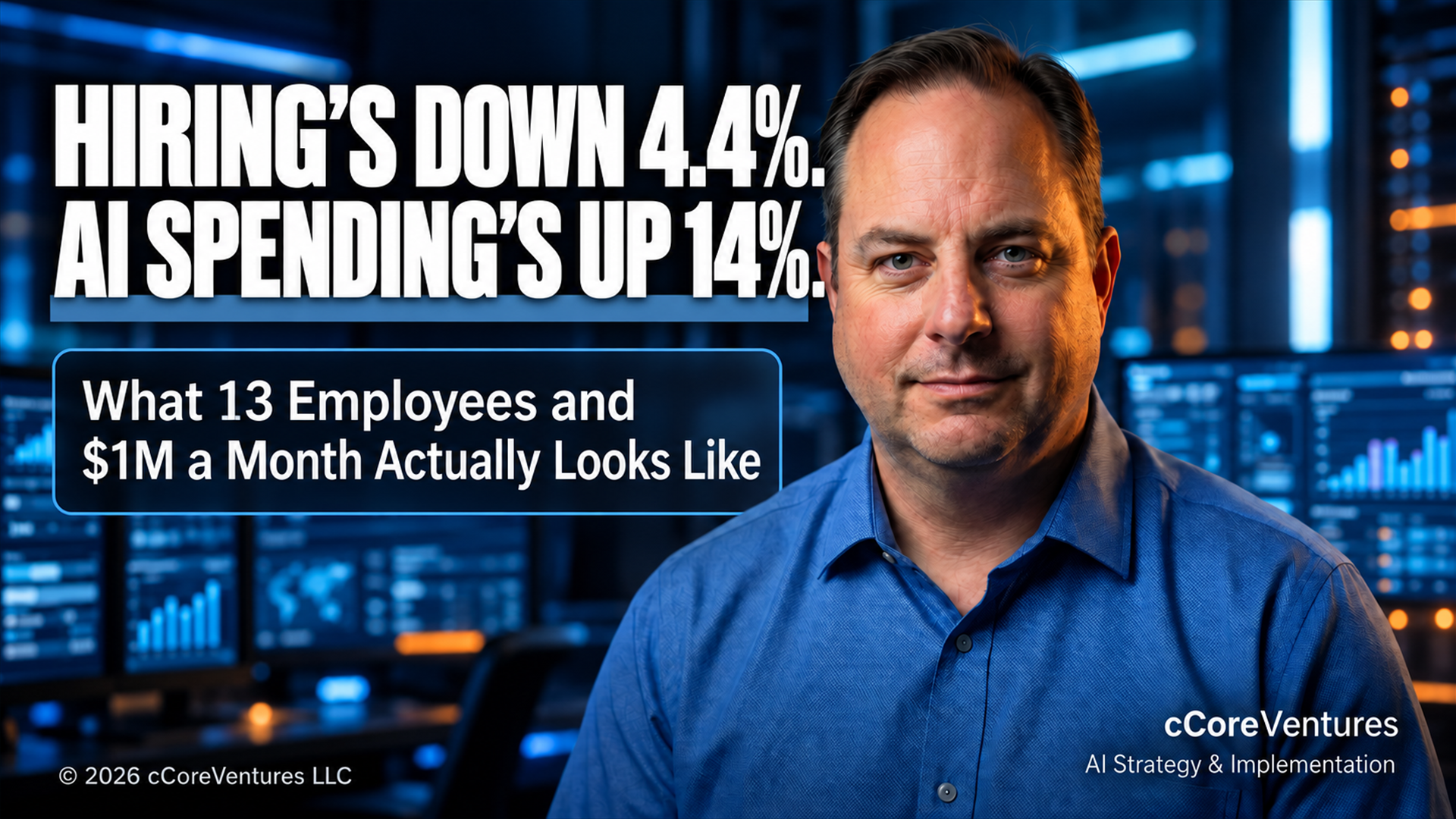
AI agents instead of employees: new 2026 data shows hiring-intent business applications down 4.4% while small business tech spending jumps 14% — and one 13-person company is running $1M a month. Here's what the numbers mean for your next hire.
Here's the headline that's technically true: small businesses are choosing AI agents over employees, right now, in measurable numbers. Bank of America Institute found that business applications with explicit plans to hire fell 4.4% even as "high-propensity" business formation — the kind the Census Bureau flags as likely to actually launch — rose 15.1% year over year in January. More businesses are starting. Fewer of them are budgeting for a first or next hire. At the same time, small business tech spending, which includes AI tools, rose about 14% year over year last month, with retail spending up more than 25%.
Translation: the money that used to open a req is opening a subscription instead.
That's a real shift, and if you're running a small business right now, it changes how you should plan your next twelve months of headcount. But here's the part most of the coverage skips: the data behind "AI is replacing employees" is a lot messier — and more useful — than the headline version. Some of it's hard numbers. Some of it's a Draper Associates partner's anecdotal read on a handful of founder conversations. Some of it's layoffs that the companies involved are actively disputing as "AI washing" rather than real automation. You need to know which parts to actually act on.
The Headline Is True. The Panic Isn't.
Start with what the data actually supports, separated from what it doesn't:
- What's confirmed: Hiring-intent business applications are down 4.4% year over year even as overall high-propensity business formation is up 15.1%. Small business tech/AI spending is up roughly 14% year over year, led by retail (+25%) and manufacturing.
- What's anecdotal: Draper Associates partner Andy Tang says the startups he's talked to are cutting engineering teams by an average of about a third, with AI tools producing three to five times the code at a nominal cost. That's a real signal worth tracking — it's not a survey of thousands of companies.
- What's disputed: Payments company Block reportedly laid off close to half its workforce last month. Some observers are calling that "AI washing" — a layoff that gets an AI label attached after the fact rather than one AI tooling actually drove. Block denies it. Challenger, Gray & Christmas found AI cited as a factor in only about 8% of all 2026 job-cut announcements — roughly 12,304 positions. That's real, but it's a small share of total cuts, not the mass-replacement story some headlines imply.
- The number that should actually worry you if you employ people: the private sector has roughly zero net job creation right now, per Fed Chair Jerome Powell, with 92,000 positions cut in February and unemployment at 4.4%. Small businesses employ about 45% of Americans. That's a tight labor market story as much as an AI story — and the two are tangled together in most of the coverage you'll see this month.
The honest read: AI agents aren't broadly replacing existing employees yet. They're increasingly replacing the next hire a growing business would have made a year ago. That's a different — and for most of you, more immediately useful — thing to plan around.
One Company, 13 People, $1M a Month
If you want to see what "AI agents instead of employees" looks like when it's working rather than when it's a headline, look at TurboAI. Two college students started it with under $300 in initial investment. It now has 8.5 million users and roughly $1 million in monthly revenue — run by 13 employees. Cofounder Rudy Arora's own estimate: a company at their current stage would have needed more than 100 employees two and a half years ago. They raised $750,000 early on and have mostly left it untouched, because the business is already profitable without spending it.
That ratio — 13 people instead of 100-plus for the same output — is the real story underneath the hiring-intent numbers. It's not that small businesses stopped wanting to grow. It's that the headcount required to hit a given revenue number just moved, and most owners haven't rebuilt their mental model of what "scaling" costs yet.
This is exactly how cCoreVentures itself got built: zero outside funding, one person, and AI tools doing the work a small team used to be hired to do — client research, content production, workflow automation, first-draft everything. The TurboAI number isn't an outlier you should expect to replicate overnight. It's a preview of what your own revenue-per-employee ratio can look like once agentic tools are actually integrated into how the business runs, not just bolted on as a side experiment one person uses occasionally.
The Readiness Gap That Will Bite You If You Skip It
This is the part the "just use AI instead of hiring" takes conveniently leave out. Adecco Group's global study of 2,000 C-suite executives across 13 countries found a real planning gap hiding behind the adoption enthusiasm:
- 45% of business leaders expect AI agents to be integrated into their workflows within 12 months.
- But only 22% are highly confident they're actually building the digital and future-ready workforce capabilities that transition requires.
- Only about a third of leaders say they use workforce data effectively to inform people and talent decisions at all.
- And just 36% say their current talent strategy clearly shows employees how AI will create opportunity for them — meaning nearly two-thirds of teams are watching this shift happen with zero communication about where they fit in it.
There's also a perception gap worth sitting with: leaders consistently underestimate how ready their own people are. More workers report feeling comfortable collaborating with AI agents than leaders expect — which cuts against the assumption that your team is the bottleneck. Often, you are. As Adecco's CEO put it, AI moves at software speed; organizational trust moves at human speed. Skipping a next hire in favor of an agent is a legitimate financial decision. Skipping the plan for how that agent fits into your existing team's workflow is how you turn a smart cost decision into a trust problem that costs you more than the salary you saved.
Three Questions Before You Skip Your Next Hire
Before you let an open role quietly disappear in favor of "we'll just use AI for that," run it through three checks:
- Is the role actually repetitive enough for this to work, with a named owner? The checklist we laid out in our breakdown of why 40% of agentic AI projects get canceled still applies here: graduated autonomy, a reversibility check, a cost baseline, and one person accountable for the outcome. A role that's mostly judgment calls isn't a good first candidate — a role that's mostly repeatable steps is.
- If the agent touches customers or money, is anyone covering the liability side? Skipping a hire to let an agent handle orders, scheduling, or billing means that agent is now doing work a human — and your insurance policy — used to be accountable for. We covered exactly where that coverage gap sits in our piece on AI agent liability for small business; read it before you expand what an agent is allowed to touch.
- Have you actually integrated AI into this function, or are you still experimenting with it? There's a wide gap between a business that's integrated AI into daily operations and one where a single employee occasionally uses ChatGPT — we broke that distinction down in our look at the small business AI integration gap. Skipping a hire only works if what replaces that role is actually running reliably, not if it's one tool one person is still figuring out.
If you can't answer all three cleanly, the honest move is to hire — or to bring in help building the integration first, so the agent you deploy instead of that hire is actually ready to carry the load.
What To Actually Do This Week
- Pull your last four open roles and sort them by "mostly repeatable" vs. "mostly judgment." The repeatable ones are your real candidates for an agent instead of a hire — not every open req on your list.
- Write down what a role actually costs today — salary, benefits, management time — before you decide an agent replaces it. You need that baseline to know if the swap actually saved money or just moved the cost somewhere less visible.
- Tell your team what's happening, even in broad strokes. With only 36% of companies communicating clearly about where AI creates opportunity for employees, silence is the default — and it's the thing most likely to turn a smart efficiency decision into a morale problem.
- Name an owner for every agent that replaces a role, not just the ones that feel high-stakes. An unowned agent doing the work of an unfilled position is exactly the kind of gap that turns into a bigger mess later.
- If you're genuinely unsure whether a role is ready to hand to an agent, treat that uncertainty as your answer for now. Hire for this cycle, build the integration properly, and revisit the decision next quarter with real data instead of a hunch.
Frequently Asked Questions
Is AI actually replacing small business jobs right now?
Mostly not existing jobs — Challenger, Gray & Christmas attributes only about 8% of 2026 job-cut announcements to AI, and some high-profile "AI layoffs" are disputed by the companies involved. What's clearly happening is businesses skipping the next hire they would have made, as hiring-intent business applications fall even while overall business formation rises.
How do I know if a role is a good candidate for an AI agent instead of a new hire?
Start with how repeatable the role is versus how much judgment it requires, confirm someone will own the agent's output, and make sure the function is actually integrated with AI already — not just lightly experimented with. If any of those three is shaky, hire instead.
Does skipping a hire for an AI agent save money if something goes wrong?
Only if you've accounted for the liability and oversight cost, not just the salary. An agent handling customer-facing or financial work without a clear owner and without insurance coverage mapped to it can cost more in cleanup than the hire would have in salary.
What should I tell my team if we're using AI agents instead of filling an open role?
Say it directly, and tie it to what it means for them — most companies aren't doing this, which is exactly why it causes unnecessary anxiety when it's left unexplained. A short, honest conversation about where the role is going and what it means for existing staff costs you nothing and prevents a trust problem down the line.
The Bottom Line
The real story in this data isn't "AI is killing jobs" — it's that the headcount a growing small business needs to hit a given revenue number just changed, and most owners are still budgeting against the old number. The businesses getting this right aren't the ones blindly leaving every open role unfilled. They're the ones running the same three checks every time: is this role actually repeatable, is someone accountable for what replaces it, and is the AI genuinely integrated instead of just available.
This is precisely the work cCoreVentures' AI Strategy & Implementation practice does for small businesses every week — figuring out which roles are legitimate candidates for agentic AI, building the integration so it actually holds up under real operating conditions, and making sure someone's name is on every agent doing work a hire used to do. If you've got an open role you're tempted to leave unfilled "because AI can probably handle it," let's find out together whether that's a smart call or an expensive guess — book a free AI strategy session with cCoreVentures before you make the decision by default.
Recent articles
- Does Google Penalize AI Content? What This Week's Authorship Crackdown Really Means for Small BusinessGoogle just warned that fake AI "authors" signal a low-quality page. Here's what actually changed in this week's spam enforcement, plus GPT-6's new interactive ChatGPT answers and two AI labs' unintended-action reports — and what small business owners should do about all three.
- 77% of Small Businesses Now Use AI Regularly. Here's Everything Else That Moved This Week (AI News Roundup — October 10, 2026)This week's AI news for small business: adoption hits 77%, Google ships a unified AI agent for business, the September spam update is finally done, and a new standard lets AI agents shop your site. Here's what each one means for you.
- Meta One Subscription for Small Business: Why Posting a Link Just Got ExpensiveMeta just started charging small businesses to post links on Instagram and Facebook. Here's what the Meta One subscription actually costs — and how to protect your traffic either way.
Explore our CoreSolutions, CoreServices, or all articles.