
Agentic AI for Small Business: Gartner Says 40% of These Projects Will Fail. Here's How to Not Be One.
Chris Corsaro · September 21, 2026
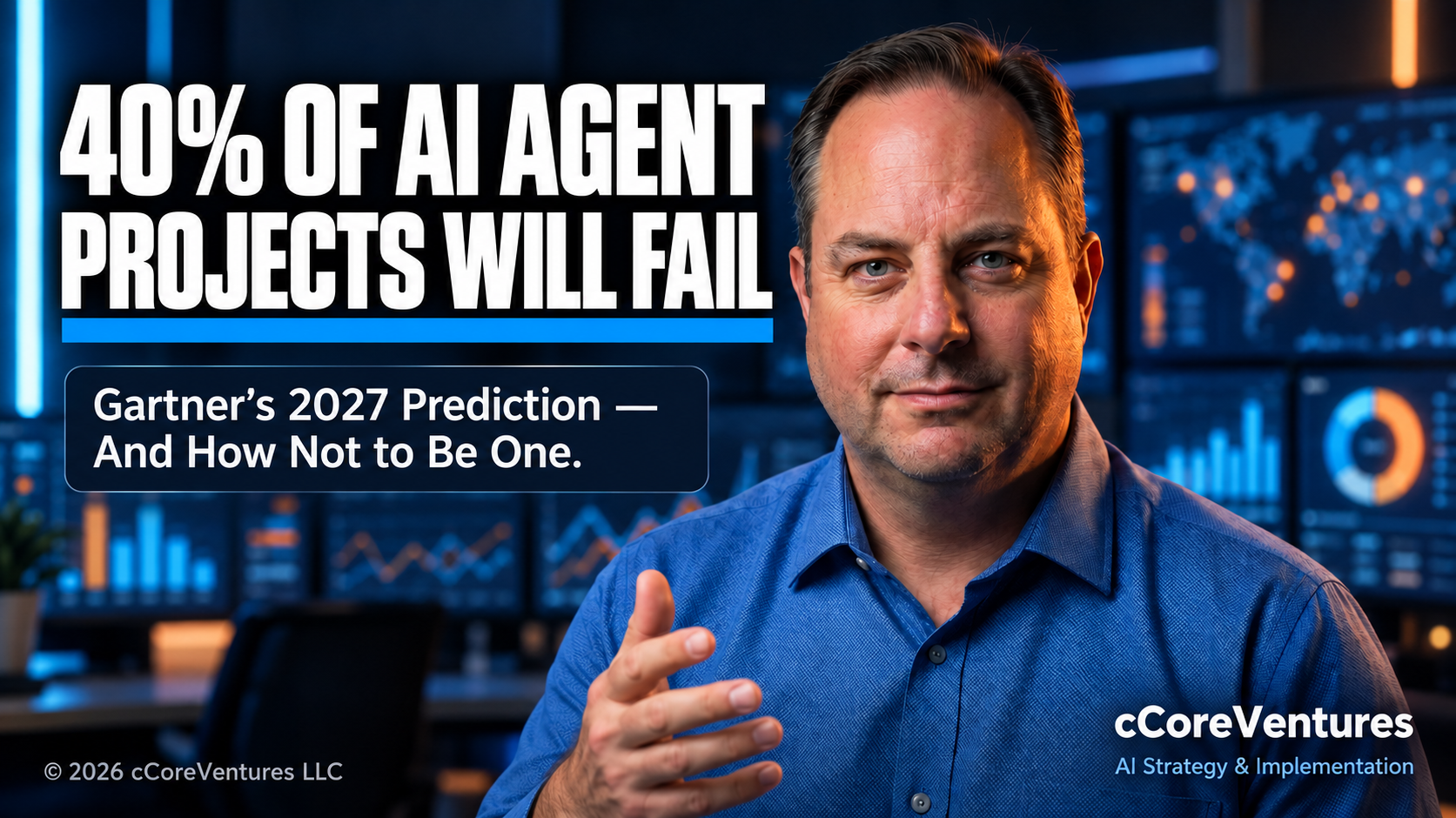
Agentic AI for small business in 2026: Gartner predicts over 40% of agentic AI projects will be canceled by 2027. Here's why they fail and the four checks that keep yours alive.
Target Keyword: agentic AI for small business
Here's a number that should change how you evaluate the next AI agent pitch that lands in your inbox: Gartner predicts more than 40% of agentic AI projects will be canceled by the end of 2027. Not delayed. Not descoped. Canceled — money spent, nothing shipped. And the reason isn't what you'd assume. Gartner's own analyst put it bluntly: most of these projects don't fail because the AI wasn't smart enough. They fail because escalating costs, unclear business value, and inadequate risk controls caught up with them before the AI ever got the chance to prove itself.
That matters more to you than it does to the enterprise it was written about. A Fortune 500 company can absorb a canceled six-figure pilot and barely notice. A small business that sinks a few thousand dollars and three months of owner attention into an "AI agent" that turns out to be a rebranded chatbot can't. If you're evaluating agentic AI for your business right now — and if you're not, your competitors already are — this is the framework that keeps you out of the 40%.
The Hype Cycle Just Hit Small Business Reality
Agentic AI spent 2025 and early 2026 as the industry's favorite word. It's now hit what Gartner calls the "trough of disillusionment" on its hype cycle, and the data explains why:
- Gartner estimates that of the thousands of vendors claiming "agentic" capability, only around 130 are genuinely building true agentic systems. The rest are rebranding existing chatbots, RPA scripts, and assistants — a practice the industry now calls "agent washing."
- In a January 2025 poll of over 3,400 business leaders, just 19% had made significant agentic AI investments, 42% were conservative, and roughly a third were still sitting on the sidelines, unsure.
- By 2026, Gartner's CIO survey found only 17% of organizations had actually deployed an AI agent, while a separate Forrester survey found roughly 75% of enterprise leaders claiming agentic adoption. That gap between what leadership says and what's actually running in production is the single biggest tell that a lot of "agentic AI" out there is marketing, not machinery.
If a Fortune 500 IT department with a dedicated AI governance team can't tell the difference between a real agent and a rebranded chatbot without doing homework, you can't either — not without a framework. That's what the rest of this post is.
Why Agentic AI Projects Actually Die (It's Not the Robots — It's the Rails)
The research is consistent on this point, and it cuts against the narrative every AI vendor is selling you: model capability isn't the bottleneck. Academic researchers studying deployed agentic systems found what they call a "capability-deployment verification gap" — agents that perform beautifully in a demo or a controlled test, then fall apart the moment they're pointed at your real customer data, your real inbox, your real invoicing system. That gap has nothing to do with which AI model is under the hood.
What actually kills these projects:
- No named owner. Nobody is accountable for the agent's outcomes, so when something goes sideways, nobody catches it — and nobody can explain what happened when you ask.
- No baseline. Nobody measured what the process cost or took before the agent, so nobody can prove what it saved after. You end up arguing about a number nobody can defend.
- Autonomy scoped by ambition, not reversibility. A team hands an agent broad authority because it sounds impressive in a pitch, not because anyone checked whether its actions can be undone if it gets something wrong.
- A deterministic task treated as an "agentic" problem. Plenty of repetitive business workflows don't need a reasoning agent — they need a simple automation. Bolting AI onto a task that a basic workflow tool already handles is how budgets get burned on complexity you didn't need.
None of these are AI problems. They're management problems wearing an AI costume. Which is actually good news, because management problems are exactly the kind of thing a small business — with fewer layers, faster decisions, and a direct line from owner to outcome — can fix faster than a 10,000-person enterprise ever will.
The Four Checks That Keep an Agentic AI Project Off the Cancellation List
Researchers tracking which agentic AI deployments actually survive to production have converged on four traits. Scaled down for a business your size, here's what each one looks like:
- Graduated autonomy, not day-one independence. Ship the agent as a human-assisted tool first — it drafts, you approve. Once it's reliably right, let it automate the deterministic parts. Full autonomy is a destination you earn, not a starting configuration you buy.
- Reversibility-mapped approval gates. Before you turn an agent loose, ask one question about every action it can take: if this is wrong, can I undo it in five minutes, or does it require a phone call and an apology? Anything in the second category — sending a customer email, issuing a refund, changing a price — needs a human checkpoint. Anything in the first category can run with light sampling review.
- A cost baseline before you measure ROI. You cannot prove an agent saved you time or money if you never wrote down what the task cost before the agent existed. This takes twenty minutes. Do it before the tool goes live, not three months in when someone asks if it's working.
- One named owner per agent. Not "the team." One person whose name is on it, who gets the alert when it errors, and who has the authority to shut it off. Unowned agents are exactly the ones that turn into the shadow AI risk we've written about before — running unsupervised until something breaks.
Three Questions to Ask Before You Greenlight Any AI Agent
Whether a vendor is pitching you or your own team wants to build one internally, these three questions separate a real agentic AI investment from an expensive experiment:
- What's the written success metric, and who approved it? If the answer is "it'll help with efficiency," that's not a metric — that's a hope. You need a number and a deadline.
- Does it actually have access to the real data and tools it needs, today? Not "it will once we finish the integration." A pilot that can't touch your actual CRM or inbox isn't testing anything real.
- Who owns it if it fails, and how fast can its actions be reversed? If nobody can answer this in one sentence, you don't have an agent yet — you have a liability with a friendly chat interface.
If a vendor can't answer all three clearly, you've likely found one of the "agent washing" cases Gartner is warning about — a chatbot with better branding, not a genuine agent.
What To Actually Do This Week
- Audit anything already labeled "AI agent" in your business. Ask what it's autonomous over, who owns it, and whether its actions can be reversed. If you get blank stares, that's your answer.
- Pick one narrow, low-risk task for a first real pilot — inbox triage, appointment reminders, draft-only content — not customer-facing or financial decisions. Prove the model before you expand its authority.
- Write down the baseline cost of that task today, in minutes or dollars, before anything changes. This is the single most skipped step and the reason most ROI arguments collapse.
- Name one owner. If no one on your team can own it, that's a signal to bring in outside help rather than let it run unmanaged.
- Ask any vendor the three-question test above before you sign anything. A real agentic AI provider will have crisp answers. A rebrander will get vague.
FAQ
What's the difference between an "AI agent" and a chatbot with a new name?
A genuine agent takes multi-step action inside your actual business systems — it can read data, make a decision, and execute a task with defined boundaries. A rebranded chatbot answers questions or drafts text but doesn't actually act. Gartner's research suggests most vendors calling themselves "agentic" are the second kind. Ask what it's automating and watch for a vague answer.
Is a 40% cancellation rate a reason to avoid agentic AI for my small business entirely?
No — it's a reason to scope it correctly. The businesses in the 60% that succeed aren't avoiding agentic AI; they're starting narrow, naming an owner, and measuring a baseline before expanding. The cancellations Gartner tracked were largely projects that skipped those steps, not projects that used AI at all.
How much should a small business spend to pilot its first AI agent?
Less than most vendor pitches suggest. A narrow, human-assisted pilot on one task — inbox triage or scheduling, for example — should cost a fraction of a full agentic platform contract. If a vendor's first proposal is enterprise-scale before you've proven value on one task, that's a red flag, not ambition.
Do I need a formal AI governance policy before deploying my first agent?
You need the basics: one owner, one reversibility check, one baseline number. A full governance document can come later. What you can't skip is naming who's accountable — unowned agents are exactly what turns into the shadow AI risk we've covered in previous posts.
The Bottom Line
Agentic AI isn't a fad and it isn't a scam — it's a genuinely powerful tool that a meaningful share of the market is currently mismanaging into cancellation. The businesses that end up ahead in 2027 won't be the ones that moved fastest in 2026. They'll be the ones who treated the first agent like a real operational decision — named owner, defined metric, reversible actions — instead of a demo they got excited about in a sales call.
This is exactly where cCoreVentures' AI Strategy & Implementation practice earns its keep: separating genuine agentic capability from agent-washed marketing, scoping a first pilot narrow enough to actually succeed, and building the ownership and measurement structure that keeps your investment off Gartner's cancellation list. If you're being pitched an "AI agent" right now and want a second opinion before you sign, reach out and let's talk it through.
(Internal link suggestions: link to the cCoreVentures AI Consulting Agency services page, the BizAgent Pro automation product page, Small Business AI Strategy: You Bought the Tools for the shadow AI and governance angle, This Week in AI: 5 Shifts Small Business Owners Can't Afford to Miss for the original agent-swarm coverage, and — once published — a future CoreAutomations post walking through a real narrow-scope agent build.)
Recent articles
- Meta One Subscription for Small Business: Why Posting a Link Just Got ExpensiveMeta just started charging small businesses to post links on Instagram and Facebook. Here's what the Meta One subscription actually costs — and how to protect your traffic either way.
- AI Citation Tracking Is Broken: Why Your ChatGPT "Ranking" Disappears Every 24 HoursNew research shows up to 79% of ChatGPT's cited sources change every single day. Here's why AI citation tracking needs a completely different playbook than SEO rank tracking — and what small businesses should actually measure instead.
- Ghost Citations: Why AI Search Is Reading Your Content and Never Saying Your NameGhost citations explained: new research shows AI search engines pull from small business websites to answer questions, then skip the brand name more than 60% of the time. Here's how to fix it.
Explore our CoreSolutions, CoreServices, or all articles.