
LinkedIn Quietly Rebuilt Its Algorithm in 2026 — Here's Why Your Company Page Reach Just Cratered
Chris Corsaro · September 25, 2026
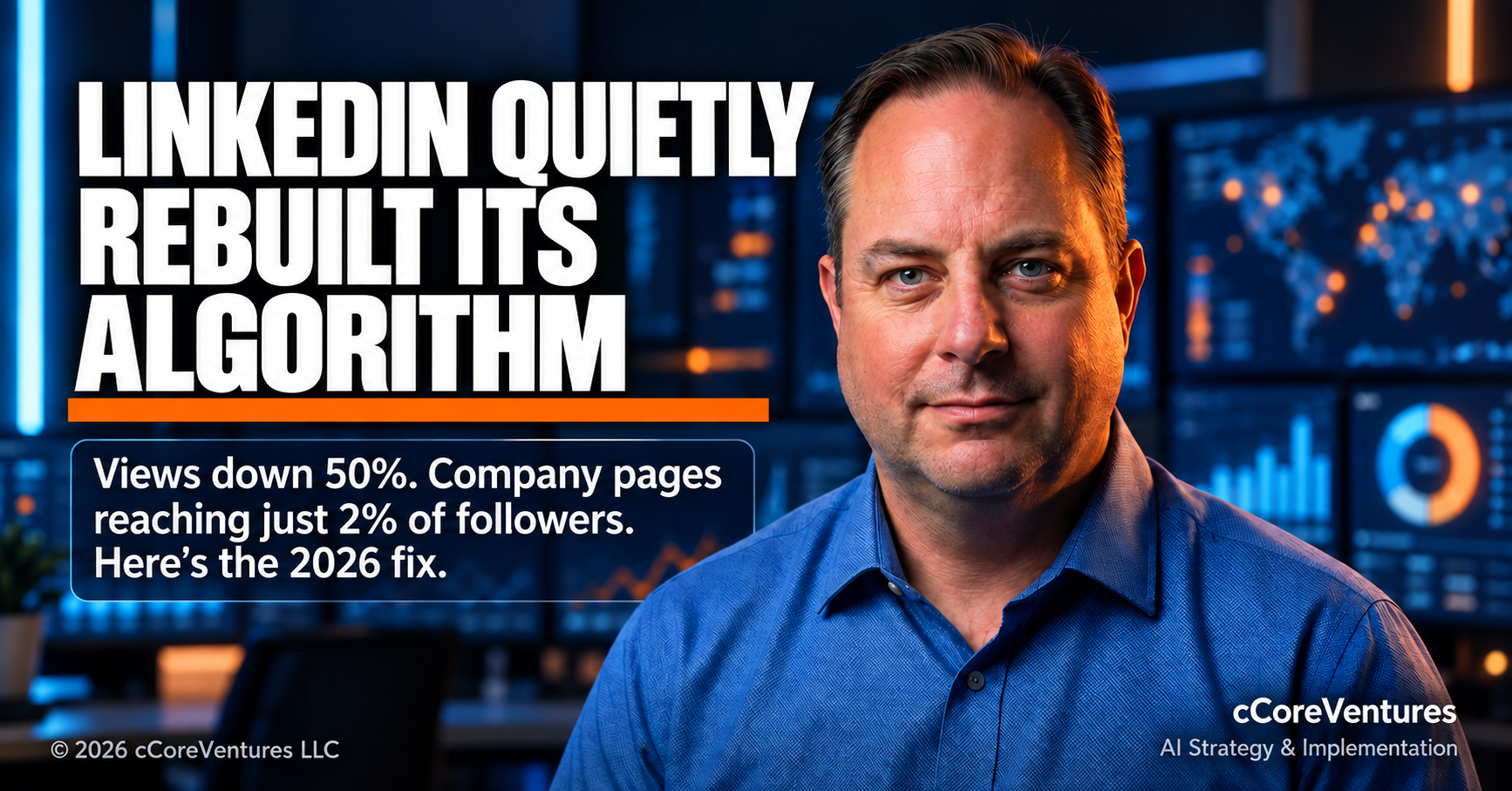
LinkedIn's 2026 algorithm rebuild for small business: views down 50%, follower growth down 59%, and company pages reaching just 2% of followers. Here's what's actually winning now.
Target Keyword: LinkedIn algorithm for small business
If you've been posting on your business's LinkedIn page all year and watching the numbers quietly circle the drain, you didn't do anything wrong. LinkedIn rebuilt the entire engine underneath you, and most small business owners never got the memo.
On March 12, 2026, LinkedIn replaced its old feed-ranking system — a patchwork of separate specialized models — with a single, unified LLM-powered retrieval and ranking system. Not a tweak. A rebuild. And the numbers from the rollout are ugly: according to Richard van der Blom's Algorithm Insights report, views fell roughly 50% year-over-year, engagement dropped 25%, and follower growth declined 59% in the period around the change. If your company page traffic quietly fell off a cliff sometime this year, this is almost certainly why — and the fix isn't what most "LinkedIn growth hacker" content is telling you.
What Actually Changed on March 12, 2026
LinkedIn didn't just adjust a ranking weight. It replaced the architecture. The old system used separate models tuned for different jobs — one for spam detection, one for relevance, one for engagement prediction — stitched together. The new system runs a single LLM-powered model that reads a post's content, the author's professional profile, and the specific reader's history together, then decides in real time whether that specific person would find that specific post valuable.
That's a fundamentally different question than the old algorithm was asking. The old system asked "will people generally engage with this?" The new system asks "would you, specifically, care about this?" That distinction is why so much content that used to perform fine now goes nowhere — it wasn't written for anyone in particular, so the new model can't find a reason to show it to anyone in particular.
The Numbers That Should Get Your Attention
A few stats worth sitting with if you run a business page or post under your own name:
- Views down ~50% year-over-year across the platform during the rollout window, per van der Blom's Algorithm Insights report.
- Engagement down 25% in the same period — likes, comments, and shares all contracted together, not just one metric.
- Follower growth down 59% — the algorithm change didn't just suppress existing posts, it slowed the rate at which pages and profiles picked up new followers.
- Company pages now reach roughly 2% of their followers with an organic post. Two percent. If you have 500 followers on your business page, a typical post is landing in front of about 10 of them.
- Personal profiles generate roughly 5x more engagement than company pages for equivalent content.
That last stat is the one that should change your posting strategy today, not eventually. If you've been funneling your content energy into "the company page" because it feels more official, the algorithm has a different opinion, and it's not close.
LinkedIn Isn't Penalizing AI Content — It's Penalizing Boring Content
Here's the nuance that most of the panicked "LinkedIn is banning AI posts!" takes are getting wrong: LinkedIn does not directly detect or penalize AI-written text. There's no AI-content flag docking your reach.
What the new model actually measures is behavioral engagement signal — specifically:
- Dwell time — does someone actually stop and read the post, or scroll past in half a second?
- Saves — did anyone bookmark it to come back to?
- Substantive discussion — are the comments real reactions, or just "Great post!" noise?
Generic AI content performs badly not because a filter caught it, but because it reads generically — no specific professional insight, no point of view a reader hasn't seen a hundred times, nothing worth stopping to read. The new algorithm is very good at noticing when nobody actually stopped. That's the real mechanism, and it's a much higher bar than "don't use ChatGPT" — plenty of AI-assisted posts do fine when the underlying idea, story, or opinion is genuinely specific to the person posting it.
This is the same pattern we've flagged across every AI-driven ranking system this year, from Google's AI Overviews rewarding structure and freshness to AI answer engines favoring named, credentialed authors over anonymous content. The systems keep converging on the same rule: specific and attributed beats generic and anonymous, everywhere, all at once.
The Format That's Actually Winning Right Now
While everyone else's engagement was falling, one format held up: document posts (LinkedIn's native carousel/PDF format). Document posts averaged 6.60% engagement in the same report — the highest of any format on the platform, and by a wide margin over single-image or plain text posts.
The mechanism is simple once you see it: document posts force a reader to swipe through multiple slides, which mechanically extends dwell time — the exact signal the new algorithm is built to reward. A single-image post gets glanced at for a second. A well-built 6-slide carousel gets read.
What To Actually Do This Week
- Stop posting from the company page as your default. Post from Chris's personal profile first, and have the company page reshare it. Personal profiles get roughly 5x the reach right now — that's not a marginal difference, it's the whole game.
- Turn your best blog posts into document/carousel posts. You're already writing structured, H2-driven content for the blog and social — repackage the sharpest 4-6 points from each post into a native LinkedIn document post instead of a single graphic. It's the highest-engagement format on the platform right now, and you already have the content.
- Write one specific opinion per post, not a summary. The new model rewards posts a specific reader would care about. "Here are 5 AI trends" reads generic. "Here's the AI mistake I watched a client almost make this week" reads specific. Same information, completely different distribution.
- Check your dwell time proxy: comments, not just likes. If a post is getting likes but zero real comments, that's a signal the content isn't earning attention, it's earning a reflex tap. Write posts that invite an actual reply — ask a real question, take a position someone might disagree with.
- Don't abandon AI-assisted writing — abandon generic AI writing. Use AI to draft faster, but make sure the final post has a specific detail, number, or opinion that only you (or your business) could have written. That's the difference the algorithm is actually measuring.
- Audit your last 10 company page posts against this. If most of them are generic company updates or reposted stock content, that's exactly the pattern getting suppressed right now — not because LinkedIn hates your business, but because nobody's stopping to read it.
Where This Fits Your Bigger AI Visibility Picture
This isn't an isolated LinkedIn story — it's the same pattern we've been tracking across every platform this month. Google's new Search Console AI reports showed the same theme: presence isn't the same as engagement, and you have to actually measure the gap instead of assuming more posts equals more reach. And the multi-platform GEO strategy shift we covered this week makes the same point from the AI-search side: engines increasingly reward specific, attributed, structured content over generic volume — LinkedIn's algorithm rebuild is that exact logic applied to your feed.
If you're running social media the way most small businesses do — a handful of posts a week, mostly from the company page, mostly generic updates — this rebuild just quietly cut your reach in half or worse, whether you noticed the drop-off or chalked it up to "algorithms are just worse now." They're not worse. They're pickier, and pickier is something you can actually win against once you know the rule.
FAQ
Did LinkedIn ban AI-generated content in 2026?
No. LinkedIn does not detect or flag AI-written posts directly. It measures behavioral engagement — dwell time, saves, and real discussion — and generic AI content tends to score poorly on those signals because it lacks specific insight, not because of an AI detector.
Why is my company page getting almost no reach compared to my personal profile?
LinkedIn's 2026 algorithm rebuild reportedly limits company page organic reach to roughly 2% of followers per post, while personal profiles generate about 5x more engagement for comparable content. If your business's LinkedIn strategy runs through the company page as the default, that's the single biggest lever to change.
What's the best-performing content format on LinkedIn right now?
Native document posts (LinkedIn's carousel/PDF upload format) averaged 6.60% engagement in recent industry reporting — the highest of any format — because swiping through slides mechanically extends the dwell time the new algorithm rewards.
Should I stop using AI tools to help write LinkedIn posts?
No — use them to move faster, but make sure the finished post has a specific opinion, number, or story that only your business could have written. The new algorithm rewards content specific readers would stop for, not content that could have come from anyone.
Stop Guessing at an Algorithm That Rewrote Its Own Rules
Most small businesses are still posting to LinkedIn like it's 2023 — company page first, generic updates, no format strategy — while the platform quietly rewired what actually earns distribution. The businesses that adjust now, while most of their competitors haven't noticed the shift, get a real window of outsized reach before everyone else catches up.
This is exactly the kind of platform-by-platform shift cCoreVentures' AI Strategy & Implementation practice tracks for small businesses — translating what changed under the hood on LinkedIn, Google, and every AI surface into a content and posting plan that actually works with the algorithm instead of against it. If you want a straight read on where your social presence actually stands, reach out and let's talk.
Recent articles
- Meta One Subscription for Small Business: Why Posting a Link Just Got ExpensiveMeta just started charging small businesses to post links on Instagram and Facebook. Here's what the Meta One subscription actually costs — and how to protect your traffic either way.
- AI Citation Tracking Is Broken: Why Your ChatGPT "Ranking" Disappears Every 24 HoursNew research shows up to 79% of ChatGPT's cited sources change every single day. Here's why AI citation tracking needs a completely different playbook than SEO rank tracking — and what small businesses should actually measure instead.
- Ghost Citations: Why AI Search Is Reading Your Content and Never Saying Your NameGhost citations explained: new research shows AI search engines pull from small business websites to answer questions, then skip the brand name more than 60% of the time. Here's how to fix it.
Explore our CoreSolutions, CoreServices, or all articles.