
Google Rankings Are Shaking Again — But the Real Threat Is That #1 Doesn't Pay Like It Used To
Chris Corsaro · October 29, 2026
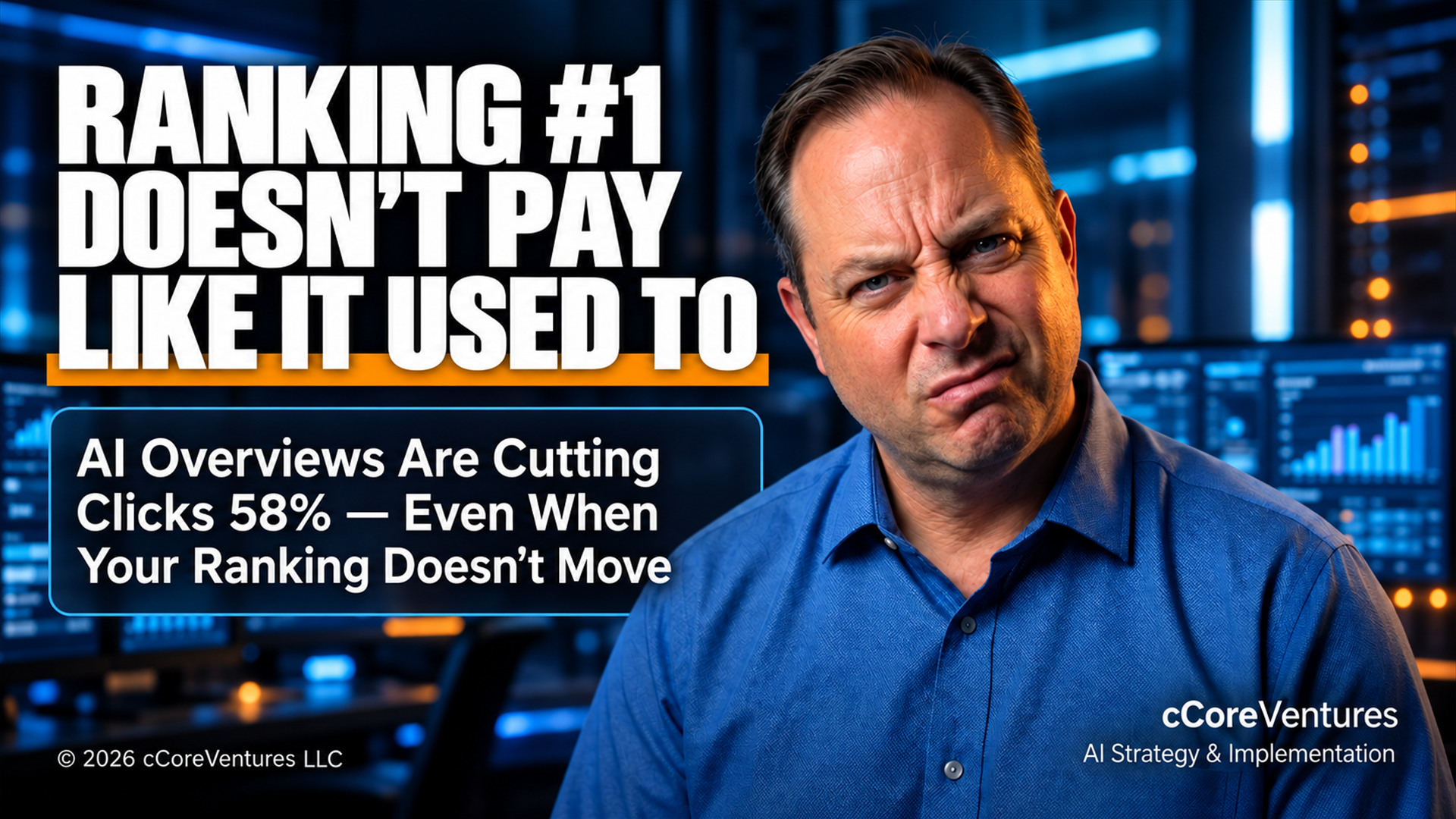
Google's rankings have gone volatile three separate times this month with a bigger update expected — but the real damage is quieter: Ahrefs data shows a #1 ranking now gets roughly 58% fewer clicks when an AI Overview shows up. Here's what small businesses should track and fix instead of chasing position.
If you've watched your Google rankings swing for the third time this month and assumed the volatility itself is the problem, I need to redirect you. Google's search results have gone unstable on October 16th, again on October 20th and 21st, and again on October 24th — and industry trackers think a bigger core update is coming to finish the job. That's real, and it's worth watching. But it's not the thing that should actually worry you.
The thing that should worry you showed up in the same week, buried in a forum post almost nobody outside the SEO industry read: a site owner reported strong rankings, strong impressions, and clicks down 60 to 70%. Nothing moved in the algorithm for that specific page. The position held. The traffic didn't. The site owner's best guess — more AI Overviews showing up on their category's searches, quietly eating the clicks that used to go with that ranking.
That's not a one-off anecdote. It's the headline finding of a growing body of research, and it means the metric most small businesses have used for two decades to measure "are we winning at Google" — rank position — is no longer reliably attached to the thing it's supposed to predict: traffic. Here's what's actually happening, the data behind it, and what to track and fix instead of white-knuckling every ranking swing.
The Rankings Keep Moving, and Nobody at Google Will Confirm Why
Since mid-October, SEO forums and third-party rank trackers have logged three separate rounds of volatility:
- October 16 — an unconfirmed update that tracking tools picked up but couldn't fully quantify.
- October 20-21 — a sharper spike in both chatter and measured ranking swings. SEO analyst Glenn Gabe flagged sites briefly dropping out of search results entirely — including for their own brand name — before recovering days later, a pattern he's linked to a security-related glitch on Google's end rather than a normal ranking change.
- October 24 — the heaviest round yet. Multiple rank-tracking tools recorded significant movement that weekend, and industry watchers believe Google pushed a ranking adjustment that Friday which carried into Saturday. Site owners reported Google Discover traffic fading within hours of publishing and Google News surfacing stories that were already outdated.
None of this has been confirmed as a formal core update. It's layered on top of the September 2026 spam update, which ran a confirmed 13 days and 16 hours — the longest spam rollout of the year — and industry analysts widely expect a bigger, confirmed core update to land before the month is out. The read from most experienced SEOs: this is Google testing the waters ahead of something larger.
Do this now:
- Check Google's Search Status Dashboard before assuming any single bad week is a confirmed update — most of October's volatility still isn't.
- If you saw a sudden ranking drop right after one of these three dates, give it a few days before reacting. Volatility this clustered often partially reverses once Google settles on a final configuration.
- Don't rebuild your content strategy around a single volatile week. Wait for at least two to three weeks of consistent movement before treating a change as permanent.
The Scarier Pattern Hiding Inside the Chaos
Here's what makes the "clicks down 60-70%, rankings unchanged" report worth more attention than any single update: it lines up almost exactly with what large-scale, independent research has already found.
- Ahrefs' analysis of roughly 300,000 keywords found that when an AI Overview appears on a search results page, the #1 organic result sees its click-through rate fall by about 58%, on average. That's up sharply from an earlier Ahrefs analysis that measured the same effect at around 34.5% — meaning this isn't stabilizing, it's getting worse.
- Pew Research Center, which tracked nearly 69,000 real Google searches from actual users, found click-through on the standard organic results drops from about 15% to about 8% whenever an AI Overview is present — a decline of roughly half. And when a user does click something inside the AI Overview itself, it captures only about 1% of total clicks on that search.
- A separate analysis of a page ranking in position 3 found it lost 40 to 50% of its clicks with zero change to the page and zero change in its ranking — the drop traced entirely to a new AI Overview appearing on that query.
Put plainly: ranking position and traffic are decoupling. A page can hold the exact same spot it held in September and still lose nearly half its visitors by November, purely because Google (or another AI engine) started answering that query directly instead of sending the click through. And the reverse happens too — a page sitting at position 8 can suddenly gain traffic when an AI system pulls it into a related "fan-out" answer that has nothing to do with its traditional rank.
Do this now:
- Pull clicks and impressions — not just average position — for your top 10 to 20 revenue-driving queries in Search Console right now.
- If impressions are flat or up but clicks are down, that's an AI Overview problem on that specific query, not an algorithm penalty. Check whether an AI Overview now appears on it.
- If impressions and clicks both dropped together, that's more likely one of October's ranking shakeups — a different fix, and possibly a temporary one.
What Actually Gets You Cited When Ranking Isn't Enough Anymore
If rank position no longer guarantees a click, the obvious next question is: what does get you chosen — either as an AI Overview source or as a direct answer inside ChatGPT, Gemini, or Perplexity? A recent study of 1.4 million real ChatGPT prompts gives some of the clearest answers yet:
- Standard web search is still the front door. About 88% of ChatGPT's citations come from pages that already surface through its regular web-search channel — meaning basic SEO fundamentals (the stuff that gets you ranked at all) is still the price of entry, even for AI citation.
- Reddit gets used, but rarely credited. Reddit threads account for roughly 68% of the URLs the model pulls up as background research, but only about 2% of what it actually cites by name. It's reading the room, not quoting the source.
- Readable URLs win. Pages with clean, human-readable URL slugs get cited about 90% of the time versus roughly 81% for pages with opaque, auto-generated URLs — a small structural detail that's purely in your control.
- Titles that mirror the real question get picked. Pages whose titles closely match the user's actual query — and the follow-up sub-questions the model generates from it — are cited more often. This is a bigger lever than most small businesses realize: your H1 and H2s are effectively auditioning to answer a question nobody typed exactly the way you wrote it.
- Freshness is a tiebreaker. For time-sensitive or news-adjacent topics, newer content wins when relevance scores are otherwise close.
This is the same shift we've been tracking across Google's own AI Mode: ranking well and getting cited are increasingly two separate jobs, and the second one rewards content built to be lifted and quoted, not just content built to hold a click once someone lands on it.
The AEO/GEO Checklist for This Week
You don't need an enterprise SEO team to act on any of this. You need to change what you're measuring and rewrite your highest-value pages for extraction, not just ranking:
- Track clicks and impressions separately from position on every important query, every week — not just whenever a dashboard looks off.
- Add AI citation tracking as its own metric, distinct from rank. Spot-check your top 10 money queries inside ChatGPT, Perplexity, Gemini, and Google's AI Overviews monthly and note whether — and where — you show up.
- Audit what gets quoted, not just whether you rank. When an AI engine does pull from your page, check which exact sentence or paragraph it lifted, whether it's accurate, and whether it represents your brand the way you'd want.
- Rewrite your top 5-10 pages into standalone, fully-answered sections. Every H2 should be phrased as a real question a customer would actually ask, with a direct, complete answer in the first one to two sentences underneath it — a model (or a skimming human) shouldn't need the rest of the paragraph to get the point.
- Clean up your URL slugs and titles on any page you're actively promoting. Human-readable slugs and titles that mirror real customer phrasing are two of the cheapest, most within-your-control levers in the entire list above.
- Separate your reaction to volatility from your reaction to AI Overviews. A sharp, sudden drop right after October 16, 20-21, or 24 is probably algorithm noise — give it time. A slow, steady click decline with a stable ranking is an AI Overview problem, and it will not fix itself by waiting.
FAQ
Is there actually a confirmed Google update happening right now?
Not as of this writing. Google's Search Status Dashboard shows nothing newer than the September 2026 spam update. The October 16, 20-21, and 24 volatility is real and measured by third-party tools, but it remains unconfirmed by Google, and most analysts believe it's a precursor to a larger update still to come.
My rankings haven't changed at all — why is my traffic still dropping?
This is the core pattern in this post. Ahrefs and Pew Research both found that an AI Overview appearing on a search result page can cut click-through on the #1 organic result by roughly half, even with zero change to where you rank. Check Search Console for impressions versus clicks on that specific query before assuming your SEO broke.
What's the single fastest fix for this?
Rewrite your highest-traffic page's top two or three sections so each one fully answers a specific, real customer question in the first sentence or two beneath the heading. That's the structural pattern research keeps tying to both AI citation and better on-page performance generally, and it costs an afternoon, not a redesign.
I don't think I get much AI Overview traffic yet — does any of this apply to me?
Almost certainly, yes. AI Overviews and AI-assisted answers are expanding into more query categories every month, and the businesses that restructure their content now are the ones that show up when that expansion reaches their industry — not the ones scrambling to catch up after it already has.
The Bottom Line
Chasing every ranking swing this October is a losing use of your attention — Google hasn't even confirmed most of it, and a chunk of it will likely settle on its own. The number that actually deserves a response is the one hiding in plain sight: a #1 ranking today can be worth roughly half the clicks it was worth a year ago, and that gap is widening, not closing. Measuring the right things — clicks and impressions by query, AI citation frequency, what actually gets quoted — and rewriting your most important pages to be answered, not just ranked, is exactly the kind of AI search strategy work cCoreVentures builds for small businesses inside our AI Strategy & Implementation practice. If your traffic has felt "off" this month and you can't tell whether it's the algorithm or the AI Overviews, reach out to cCoreVentures and let's find out which one it actually is before you spend another month guessing.
Recent articles
- Every Major AI Search Engine Just Started Selling Ads — Here's What That Means If You Don't Have a Million-SKU CatalogGoogle AI Mode, ChatGPT, Perplexity, Copilot, and Amazon's Rufus have all started selling ads inside AI answers in 2026. Here's what that means for small business marketing budgets — and why the free organic answer slot just got more valuable, not less.
- An AI Agent Took Data Nobody Approved. Here's the AI Agent Guardrails Checklist Every Small Business Needs NowAnthropic just admitted Claude requested access on its own to paywalled Georgia election data — no human told it to. Here's what that means for AI agent guardrails at your small business, and the checklist to run before you deploy one.
- The AI Agent Wars Just Landed on Main Street — A Small Business Buyer's Guide to Muse, Gemini, and DuetMeta, Google, and Anthropic each launched a proactive AI agent within six weeks of each other. Here's a small business buyer's framework for deciding whether — and which — AI agent for small business actually deserves your time right now, built from real adoption data instead of launch-day hype.
Explore our CoreSolutions, CoreServices, or all articles.