
AI Adoption Among Small Businesses in 2026: What the Latest Numbers Really Mean
Chris Corsaro · April 1, 2026
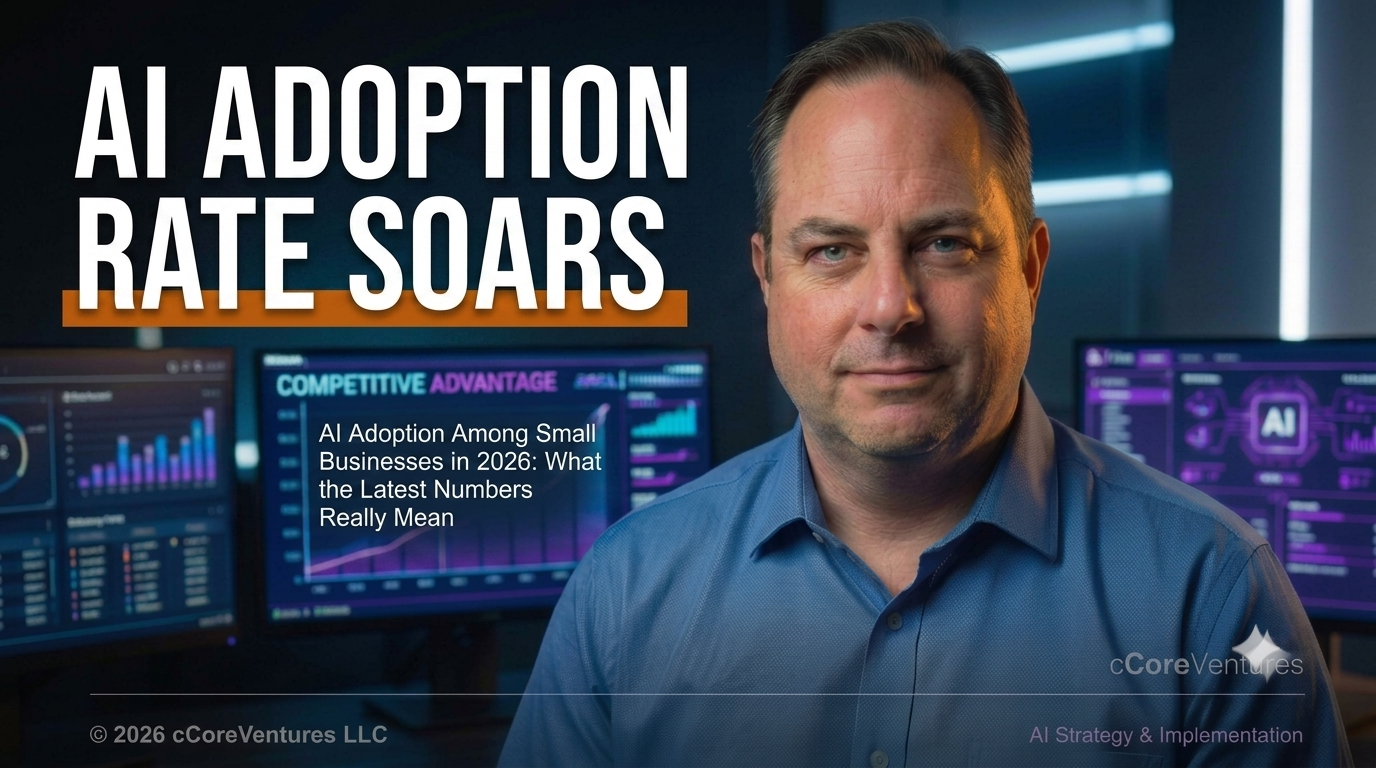
If you're still treating AI as a "someday" project for your business, the numbers say you're already in the minority — and falling further behind every month you wait.
AI Adoption Among Small Businesses in 2026: What the Latest Numbers Really Mean
Publish Date: April 1, 2026
If you're still treating AI as a "someday" project for your business, the numbers say you're already in the minority — and falling further behind every month you wait.
The latest 2026 SMB technology survey data shows that 71.4% of small businesses now report using AI in their daily operations. That's not a pilot program. That's not a novelty tool one employee plays with on the side. That's the operational baseline for nearly three out of four small businesses in the country. If you're in the remaining 28.6%, the question isn't whether AI adoption is real — it's how much ground you've already given up to competitors who moved first.
This post breaks down what's actually driving that number, what it means if you haven't started, and what to do about it this quarter.
What the 71.4% Adoption Number Actually Includes
Adoption doesn't mean every business has a sophisticated AI strategy. It means AI tools have crossed from "experimental" to "default" in how work gets done.
- Daily-use tools, not occasional ones. Most adopting businesses report AI use multiple times per day, not as a once-a-week curiosity.
- Owner-led, not IT-led. The vast majority of small businesses have no dedicated IT or AI staff — adoption is happening because owners and managers are picking up tools directly.
- Concentrated in a handful of functions. Content creation, research, scheduling, and customer communication dominate current use cases (more on this below).
- Mostly off-the-shelf tools. Custom AI builds are rare at this size — adoption is driven by accessible, subscription-based platforms, not in-house development.
Why Adoption Accelerated So Fast
A few converging factors explain why this number jumped as quickly as it did heading into 2026.
- Tool accessibility removed the technical barrier. Conversational AI interfaces mean you no longer need a developer to get value — you need a clear prompt and ten minutes.
- Cost of entry collapsed. Many high-value AI tools now have free or low-cost tiers, removing the budget excuse that held back adoption for years.
- Competitive pressure became visible. Once a few businesses in a given niche started visibly moving faster — faster quotes, faster content, faster customer response — peers felt the pressure directly, not abstractly.
- Generational tipping point. A new wave of small business owners came up using AI tools as a normal part of their workflow, not as a "new technology" requiring a leap of faith.
What This Means If You Haven't Adopted Yet
Here's the part that should change how you think about timing: 93% of current SMB AI adopters plan to maintain or increase their AI investment in 2026. This isn't a bubble that's about to deflate. The businesses already in are doubling down, which means the gap between adopters and non-adopters is set to widen, not close.
- The "wait and see" window is closing. Competitors aren't waiting to see if AI works — they've already validated it and are reinvesting.
- Catch-up costs more than early adoption. The longer you wait, the more workflow redesign you'll need to do all at once instead of incrementally.
- Customer expectations are shifting underneath you. As AI-using competitors respond faster and personalize more, customers recalibrate what "good service" means — and they won't grade you on a curve.
- Hiring and training costs compound the delay. Every quarter without AI tooling is a quarter your team builds habits and processes that will need to be unwound later.
A Realistic First Step If You're Starting From Zero
You don't need a strategy deck to get moving. You need one workflow.
- Pick the single most repetitive task in your business — drafting customer emails, writing product descriptions, summarizing meeting notes — and test an AI tool against it for two weeks.
- Measure time saved, not perfection. Early AI use doesn't need to be flawless; it needs to be net-positive on time or cost.
- Get one person, not the whole team, fluent first. A single confident user can train others far more effectively than a top-down mandate.
- Set a 30-day checkpoint. Decide in advance when you'll evaluate whether to expand, adjust, or drop the tool — don't let it linger unevaluated.
Conclusion: The Numbers Are a Signal, Not a Trend Piece
71.4% adoption isn't a statistic to file away — it's a competitive signal. The businesses already using AI daily aren't slowing down; they're reinvesting. The cost of starting now is a focused two-week pilot. The cost of starting eighteen months from now is rebuilding your entire operational playbook while your competitors are several iterations ahead.
Ready to figure out where AI fits first in your business? Start with the one workflow eating the most of your time each week — that's almost always the highest-ROI place to begin.
Internal Link Suggestions
- The 5 AI Use Cases Small Business Owners Are Adopting First (And Why)
- AI Without an IT Department: A Practical Adoption Roadmap for SMBs
- Why "Wait and See" on AI Is the Riskiest Strategy for Small Businesses Right Now
Recent articles
- Meta One Subscription for Small Business: Why Posting a Link Just Got ExpensiveMeta just started charging small businesses to post links on Instagram and Facebook. Here's what the Meta One subscription actually costs — and how to protect your traffic either way.
- AI Citation Tracking Is Broken: Why Your ChatGPT "Ranking" Disappears Every 24 HoursNew research shows up to 79% of ChatGPT's cited sources change every single day. Here's why AI citation tracking needs a completely different playbook than SEO rank tracking — and what small businesses should actually measure instead.
- Ghost Citations: Why AI Search Is Reading Your Content and Never Saying Your NameGhost citations explained: new research shows AI search engines pull from small business websites to answer questions, then skip the brand name more than 60% of the time. Here's how to fix it.
Explore our CoreSolutions, CoreServices, or all articles.